Âfâk ve Enfüs · First reflection
Night and Day
يُكَوِّرُ اللَّيْلَ عَلَى النَّهَارِ وَيُكَوِّرُ النَّهَارَ عَلَى اللَّيْلِ
He wraps the night around the day, and the day around the night. — az-Zumar 5
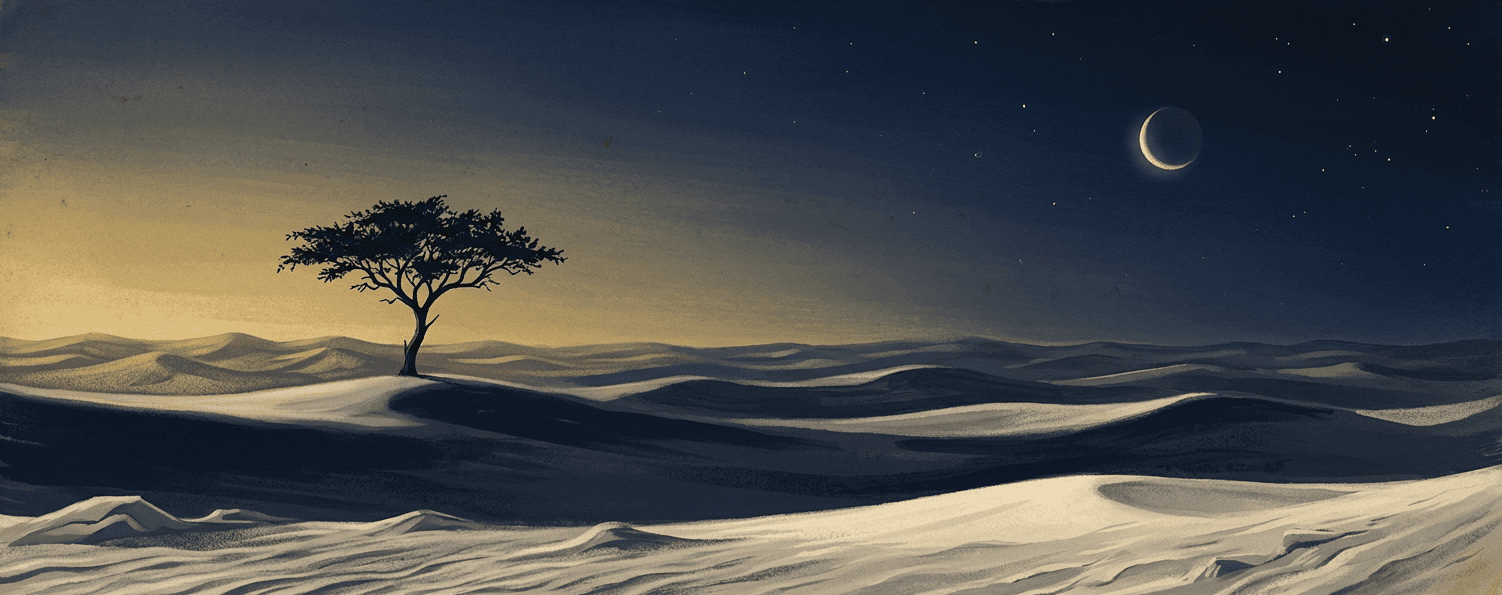
Every evening the sky winds itself around our heads like a turban. Every morning it is unwound. We have seen it so often that we no longer see it.
Verse 86 of Sūrat an-Naml breaks this habit: We made the night dark so that you may rest, and the day bright so that you may see. It sounds like an ordinary sentence. But open Yūnus 67, and almost the same sentence meets you there, with a single difference. One ends “for people who believe,” the other “for people who hear.”
This small difference opens a great door. The Qur’an describes the same scene again and again, and each time it changes the ending: for those who hear, for those who reason, for those who reflect, for those who give thanks. This piece is an invitation to step through that door: toward the sky turning on the horizon, and toward the eye closing within us. Both at once.
I · On the horizon
Three verbs, three pictures
The Qur’an does not describe the exchange of night and day with a single word. It uses three different verbs, and each one paints a different picture.
Takwīr: winding a turban around the head. Night is wrapped over day, layer upon layer, and day over night. Only a round surface can be wrapped like this. The verse does not say so, but it paints the picture that way.
خَلَقَ السَّمَاوَاتِ وَالْأَرْضَ بِالْحَقِّ يُكَوِّرُ اللَّيْلَ عَلَى النَّهَارِ وَيُكَوِّرُ النَّهَارَ عَلَى اللَّيْلِ وَسَخَّرَ الشَّمْسَ وَالْقَمَرَ كُلٌّ يَجْرِي لِأَجَلٍ مُسَمًّى أَلَا هُوَ الْعَزِيزُ الْغَفَّارُ
He created the heavens and the earth in truth. He wraps the night around the day and wraps the day around the night. He has made the sun and the moon subservient, each running for an appointed term. Truly, He is the Almighty, the Ever-Forgiving.
Salkh: stripping off a skin. Sūrat Yā-Sīn presents the night as a sign and says that the day is peeled away from it. So darkness is the ground beneath everything; light is a garment drawn over it, taken off when evening comes. Darkness is the host, light the guest.
وَآيَةٌ لَهُمُ اللَّيْلُ نَسْلَخُ مِنْهُ النَّهَارَ فَإِذَا هُمْ مُظْلِمُونَ
And a sign for them is the night: We strip the day from it, and at once they are in darkness.
Ikhtilāf: following one another. Night succeeds day, and day succeeds night. Neither outruns the other, neither catches the other. Al-Furqān 62 calls this succession an order made “for whoever wishes to reflect or wishes to be grateful.”
وَهُوَ الَّذِي جَعَلَ اللَّيْلَ وَالنَّهَارَ خِلْفَةً لِمَنْ أَرَادَ أَنْ يَذَّكَّرَ أَوْ أَرَادَ شُكُورًا
And it is He who made the night and the day follow one another, for whoever wishes to reflect or wishes to be grateful.
II · Measure
The stations of the moon
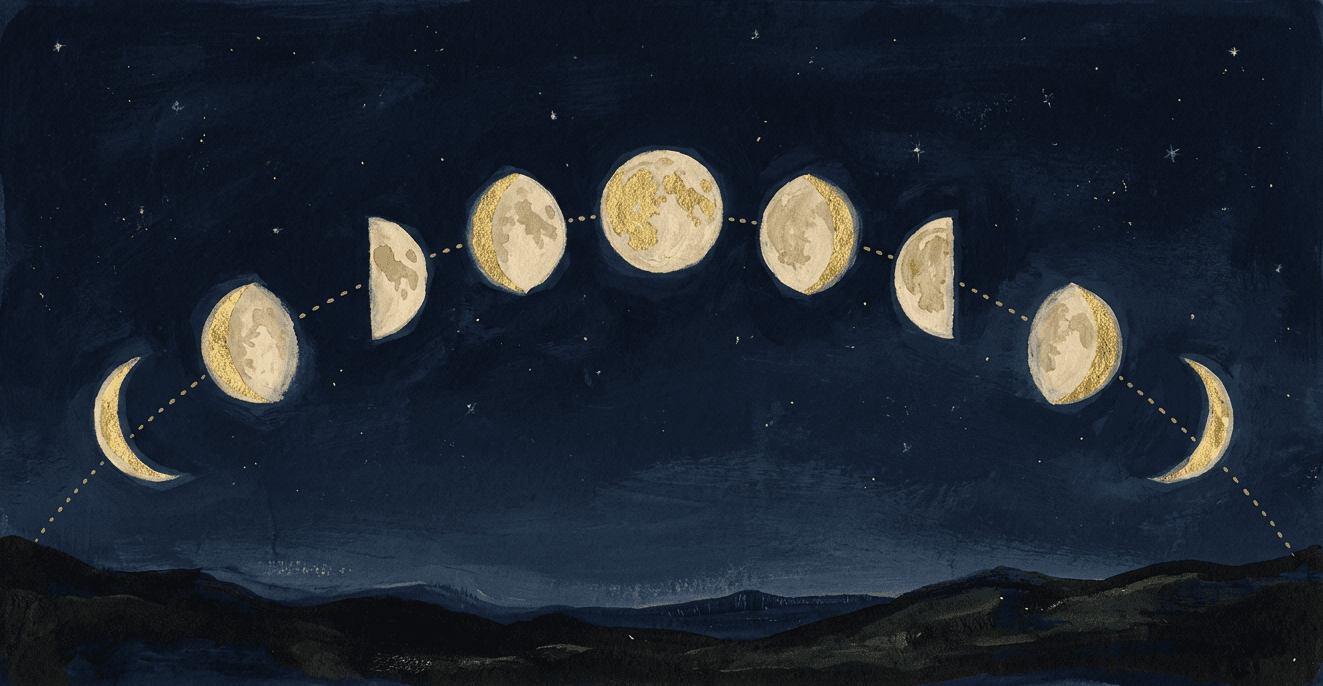
To the sun, radiance, ḍiyāʾ; to the moon, light, nūr. One burns of itself, the other gives back what it receives. Then stations are measured out for the moon. Each night it halts at one, thins, fills, and thins again. A calendar is nothing but the sum of these halts.
هُوَ الَّذِي جَعَلَ الشَّمْسَ ضِيَاءً وَالْقَمَرَ نُورًا وَقَدَّرَهُ مَنَازِلَ لِتَعْلَمُوا عَدَدَ السِّنِينَ وَالْحِسَابَ مَا خَلَقَ اللَّهُ ذَٰلِكَ إِلَّا بِالْحَقِّ يُفَصِّلُ الْآيَاتِ لِقَوْمٍ يَعْلَمُونَ
It is He who made the sun a radiance and the moon a light, and measured out stations for it, so that you might know the number of years and the reckoning. God did not create this except in truth. He sets out the signs in detail for people who know.
Translations always fall a little short before this word. One has to return to the word itself: qaddara, to set a measure. To give being a quantity, a limit, a consistency. And in the middle of the verse, a brief qualification: bi-l-ḥaqq. Not in vain, not as idle talk, but according to a truth.
The verse ends “for people who know,” and that is a summons: learning the signs of creation is also part of worship. The moon’s orbit is as much a sign as it is a topic in physics. Whoever leaves its reading to others keeps half the book closed.
III · Night
As close as a garment
Sūrat an-Nabaʾ sums up a whole life in three short sentences: We made your sleep a cutting-off, your night a garment, your day a livelihood.
وَجَعَلْنَا نَوْمَكُمْ سُبَاتًا
And We made your sleep a cutting-off,
وَجَعَلْنَا اللَّيْلَ لِبَاسًا
and made the night a garment,
وَجَعَلْنَا النَّهَارَ مَعَاشًا
and made the day for livelihood.
Libās, garment. A garment covers, warms, protects, and it rests closest to what is most private. The Qur’an uses this same word when it calls spouses a garment for one another. The night is that close to us too: a quilt drawn over us in a room no one else sees.
Subāt, to cut off. That is why Saturday is called sabt: the day work is cut off. Sleep cuts the thread of the day. Movement stops, sound withdraws, eyes close. The next morning a new thread is tied.
Al-Furqān 47 describes the same scene, and many translations render the day there as “a time for work.” The Arabic word is nushūr: the word for rising from the grave, for resurrection. The translation narrows the meaning here. The verse does not call the day working hours, but a rising.
وَهُوَ الَّذِي جَعَلَ لَكُمُ اللَّيْلَ لِبَاسًا وَالنَّوْمَ سُبَاتًا وَجَعَلَ النَّهَارَ نُشُورًا
It is He who made the night a garment for you, and sleep a rest, and made the day a rising.
IV · Within us
Every night a small death
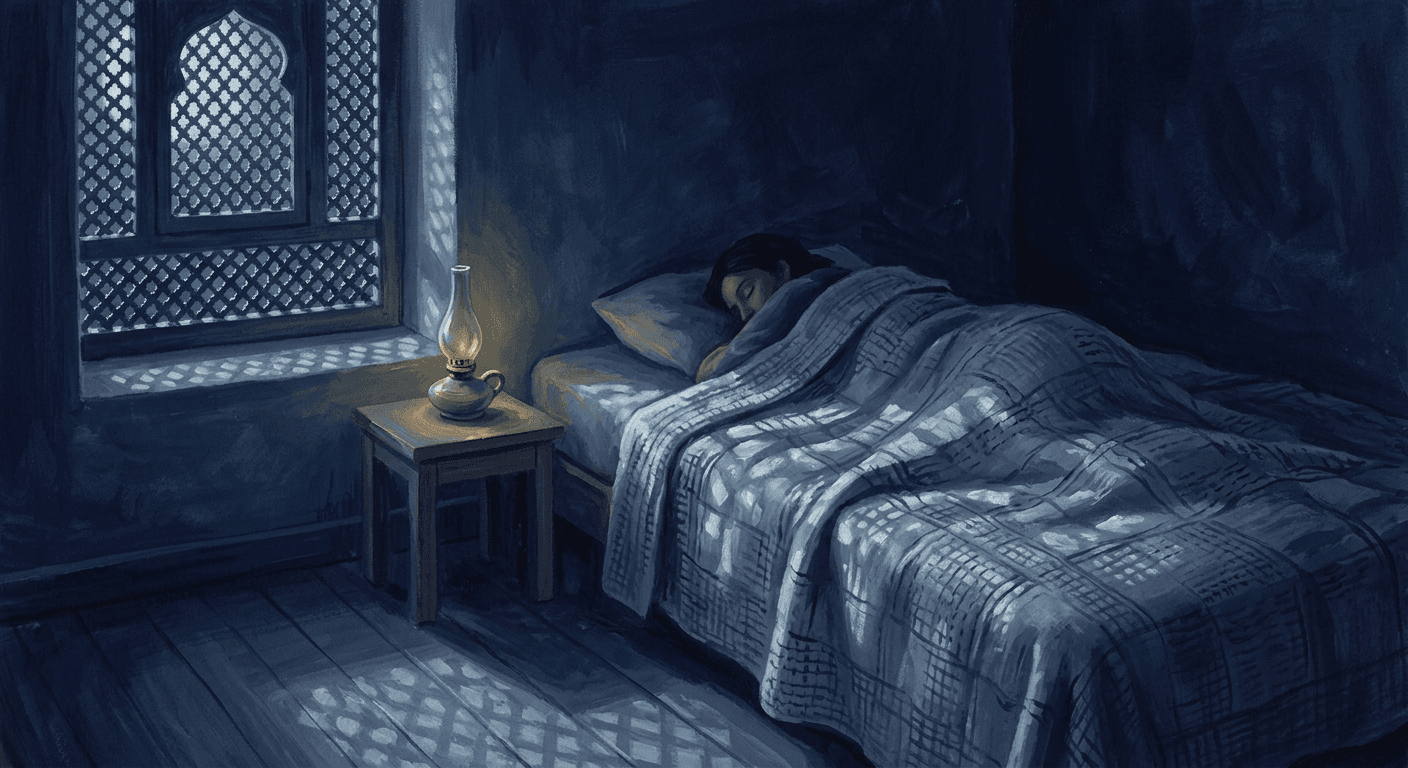
Az-Zumar 42 places sleep in the same sentence as death. God takes the souls at the moment of death and at the moment of sleep; He keeps the one whose death He has decreed and sends the other back until an appointed term. Waking each morning is that sending-back itself.
اللَّهُ يَتَوَفَّى الْأَنْفُسَ حِينَ مَوْتِهَا وَالَّتِي لَمْ تَمُتْ فِي مَنَامِهَا فَيُمْسِكُ الَّتِي قَضَىٰ عَلَيْهَا الْمَوْتَ وَيُرْسِلُ الْأُخْرَىٰ إِلَىٰ أَجَلٍ مُسَمًّى إِنَّ فِي ذَٰلِكَ لَآيَاتٍ لِقَوْمٍ يَتَفَكَّرُونَ
God takes the souls at the time of their death, and those that have not died, in their sleep. He keeps those for whom He has decreed death and sends the others back until an appointed term. Surely in that are signs for people who reflect.
When the Messenger of God woke, he would pray:
الْحَمْدُ لِلَّهِ الَّذِي أَحْيَانَا بَعْدَ مَا أَمَاتَنَا وَإِلَيْهِ النُّشُورُ
Praise be to God, who gave us life after He had caused us to die, and to Him is the rising.
The last word of the prayer is again nushūr. The name al-Furqān 47 gives to the day returns on the tongue of the one who wakes. Every morning a small Day of Rising, every waking a small resurrection.
The body has its own share in this. At night the eye closes, the organs fall quiet, and the body that carried the day’s load empties itself and restores its balance. Those who study sleep today say something similar: body and mind repair themselves most in the dark. Night is not a loss; it is a workshop of mending.
V · A thought experiment
If the night lasted until the Day of Rising
Sūrat al-Qaṣaṣ asks the reader a question: if God made the night last over you until the Day of Resurrection, who would bring you light? Then it asks the same question about the day.
قُلْ أَرَأَيْتُمْ إِنْ جَعَلَ اللَّهُ عَلَيْكُمُ اللَّيْلَ سَرْمَدًا إِلَىٰ يَوْمِ الْقِيَامَةِ مَنْ إِلَٰهٌ غَيْرُ اللَّهِ يَأْتِيكُمْ بِضِيَاءٍ أَفَلَا تَسْمَعُونَ
Say: Have you considered? If God made the night last over you until the Day of Resurrection, what god other than God could bring you light? Will you not hear?
قُلْ أَرَأَيْتُمْ إِنْ جَعَلَ اللَّهُ عَلَيْكُمُ النَّهَارَ سَرْمَدًا إِلَىٰ يَوْمِ الْقِيَامَةِ مَنْ إِلَٰهٌ غَيْرُ اللَّهِ يَأْتِيكُمْ بِلَيْلٍ تَسْكُنُونَ فِيهِ أَفَلَا تُبْصِرُونَ
Say: Have you considered? If God made the day last over you until the Day of Resurrection, what god other than God could bring you a night in which to rest? Will you not see?
Look closely at how the two verses end. After the endless night: “Will you not hear?” After the endless day: “Will you not see?” In darkness the eye does not work, but the ear does. In daylight the eye awakens. The verse calls each sense in its own hour.
وَمِنْ رَحْمَتِهِ جَعَلَ لَكُمُ اللَّيْلَ وَالنَّهَارَ لِتَسْكُنُوا فِيهِ وَلِتَبْتَغُوا مِنْ فَضْلِهِ وَلَعَلَّكُمْ تَشْكُرُونَ
Out of His mercy He made for you the night and the day, that you may rest in it and seek of His bounty, and that perhaps you will be grateful.
VI · Verse endings
One scene, five different endings
The verses about night and day closely resemble one another, but their endings are not the same. Each ending calls forth a different face of the human being turned toward God. Set side by side, these endings line up like a staircase: one that begins with hearing and climbs to gratitude, and from gratitude to praise. Touch a step.
Step 1 · root س م ع
Hearing
Not a sound striking the ear, but a word taken inside and finding a response.
هُوَ الَّذِي جَعَلَ لَكُمُ اللَّيْلَ لِتَسْكُنُوا فِيهِ وَالنَّهَارَ مُبْصِرًا إِنَّ فِي ذَٰلِكَ لَآيَاتٍ لِقَوْمٍ يَسْمَعُونَ
It is He who made the night for you to rest in, and the day to see by. Surely in that are signs for people who hear. Yūnus 67
وَمِنْ آيَاتِهِ مَنَامُكُمْ بِاللَّيْلِ وَالنَّهَارِ وَابْتِغَاؤُكُمْ مِنْ فَضْلِهِ إِنَّ فِي ذَٰلِكَ لَآيَاتٍ لِقَوْمٍ يَسْمَعُونَ
And among His signs is your sleep by night and by day, and your seeking of His bounty. Surely in that are signs for people who hear. ar-Rūm 23
Reflection Catching a sound is the ear’s work; hearing is the mind’s. Call to an animal and it catches the sound, but it does not hear. The question “Did you hear?” really asks “Did you understand, did you accept?”
This ending appears in 5 verses of the Qur'an → see allThe staircase is a suggested reading. The endings of Yūnus 5, “for people who know,” and Yūnus 6, “for people who are mindful of God,” also stand at the edge of the same scene. For an index of every verse ending across the Qur’an, see the Verse endings page.
VII · Words
Night in the Qur’an, day in the Qur’an
The Qur’an names the night with the word layl in 84 places, and the day with the word nahār in 57. When it speaks of one single night, it chooses another word: layla. The Night of Decree is such a night; a single night chosen from among all nights.
- ٱلَّيْل
- 84
- layl · night
- ٱلنَّهَار
- 57
- nahār · day
But these words speak most when they stand side by side. Night and day often appear in the Qur’an as a pair, like the two wings of one sentence. Each gives meaning to the other. The subtlety that pairs night with hearing and day with seeing is born from within this companionship.
VIII · Morning
Praise is the first and the last word
وَهُوَ اللَّهُ لَا إِلَٰهَ إِلَّا هُوَ لَهُ الْحَمْدُ فِي الْأُولَىٰ وَالْآخِرَةِ وَلَهُ الْحُكْمُ وَإِلَيْهِ تُرْجَعُونَ
And He is God; there is no god but Him. To Him belongs praise in the first life and the last. His is the judgment, and to Him you will be returned.
Just before it asks its question about night and day, Sūrat al-Qaṣaṣ says this: praise belongs to Him in this world and the next. First praise, then the sign. As if the reader were told: before you answer the question, know where you are standing.
One day a person should ask: in all my life, how many times have I looked at a tree, a bird, a cloud, and said al-ḥamdu li-llāh? Perhaps this is the only claim this piece makes: to pause for a moment tonight as the sun goes down. To put on the covering of night like a garment. And on waking in the morning, knowing that the return is to Him, to make praise the first word.
Every morning a rising. Every evening a trust. In between, blessings we could never finish counting.
وَآتَاكُمْ مِنْ كُلِّ مَا سَأَلْتُمُوهُ وَإِنْ تَعُدُّوا نِعْمَتَ اللَّهِ لَا تُحْصُوهَا إِنَّ الْإِنْسَانَ لَظَلُومٌ كَفَّارٌ
And He gave you of all that you asked of Him. If you tried to count the blessings of God, you could never number them. Truly, the human being is most unjust, most ungrateful.
Reading path
Station by station
A reading that begins at an-Naml 86 and reaches Ibrāhīm 34. Each station opens the page of its verse; you can carry the piece further with your own reading.
- an-Naml 86
The door
Night for rest, day for seeing. The last word: those who believe. The journey begins by looking for verses that resemble this one.
- Yūnus 5–6
Measure and truth
Radiance and light, the stations of the moon, “bi-l-ḥaqq.” The translation stays narrow; one must return to the word, to taqdīr. Learning the signs of creation is part of worship too.
- Yūnus 67 · ar-Rūm 23
Hearing
Catching a sound is the ear’s work, hearing is the mind’s. Almost the same sentence as an-Naml 86, but a different ending.
- al-Furqān 61–62
Succession
Night and day follow one another. For those who wish to reflect or to give thanks. Thanks takes the form of the gift.
- al-Jāthiya 13
Subservience
All that is in the heavens and on the earth has been made subservient to you. For people who reflect.
- Ibrāhīm 32–34
The uncountable
Night and day are among the blessings listed. You cannot count them. The human being is truly unjust, truly ungrateful.
Questions for reflection
- An-Naml 86 and Yūnus 67 describe the same scene. Why do you think one ends with faith and the other with hearing?
- Al-Qaṣaṣ 71 asks of the night, “Will you not hear?”, and 72 asks of the day, “Will you not see?” Is there something in your daily life that only the night lets you hear?
- In al-Furqān 47 the word “nushūr” was chosen for the day. What changes if you experience waking in the morning as a rising?
- The thanks for a gift is “of its own kind.” What might the thanks for the night be?